
Belugas May Communicate By Warping A Blob Of Forehead Fat
by Linda Tu
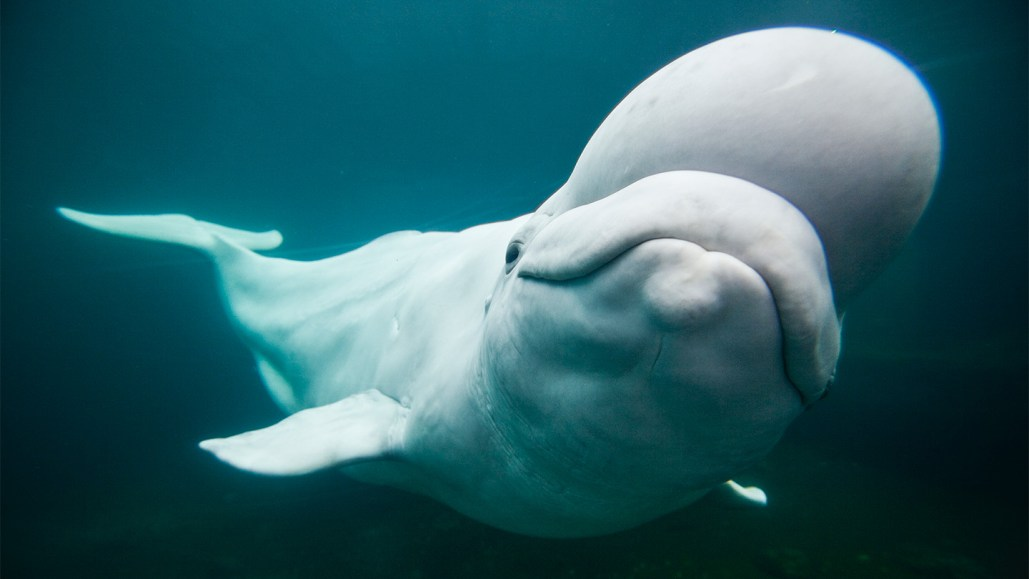
Beluga whales like this one at Connecticut’s Mystic Aquarium sport a blob of forehead fat called a “melon.” The cetaceans contort the melon into different shapes, possibly to communicate with each other.
Beluga whales are extraordinary animals in several intriguing ways.
They can congregate in large social groups, of hundreds or even thousands of individuals. They are not a matrilineal social group and may have family as well as non-family members in the group.
Large social groups, like humans, have developed communication skills such as language and physically expressive behaviors to be able to communicate with one another. Other primate animals such as chimpanzees are social creatures and they have been shown to be expressive and vocal in their interactions with other group members. They have facial expressions that correlate, we suppose, with the facial expressions that human communication uses such as smiles and frowns. The odontocetes (toothed whales) do not have facial muscles to produce smiles or frowns, their faces are fixed like a mask.
Beluga whales are considered unique among odontocetes in their ability to visibly alter the appearance of their head by changing the shape of the melon (Figure 1).
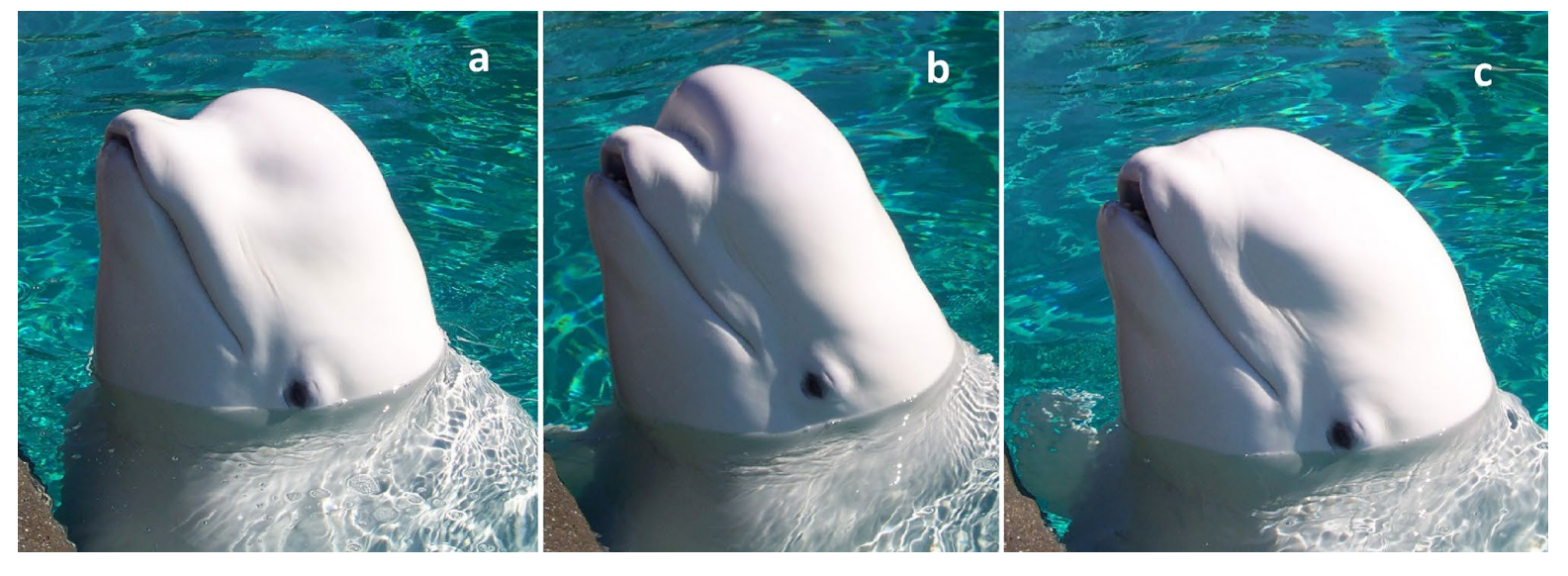
A trained beluga demonstrating the ability to voluntarily change the shape of the melon from the relaxed position (a), to extended rostrally (b) and retracted posteriorly(c)
The melon is a fatty organ that occurs in these whales for which humans have no analogous structure. It is known to be used as an echolocation devise among these animals but it may have another function in belugas and possibly in some other social whales. This is communication between individuals.
In the study cited below belugas in captivity were observed to be able voluntarily to change the shape of their melon. Five different shapes were identified, but there may be many more. It was observed that they did this when in close visual contact with another beluga, and often in socially identifiable contexts such as courtship, friendly, or aggressive behavior. More than 90% of the shape changes occurred only when another whale could see what was happening.
One characteristic move is for a male beluga to shake his melon forwards and backwards rapidly to entice a female. It might be important in this species to be the first successful suitor, as it appears to be the female who will choose a male with whom to copulate and thereupon to stimulate ovulation.
Another thing about belugas is that the seem to be very chatty, the whales’ near-constant stream of whistles, chirps, squeals and clicks have earned belugas the moniker “canaries of the sea.” It is tempting to suppose that these animals communicate in complex modes, much as humans do.
As with so many initial observations, like this one, much more research is needed. For instance, what are mother-calf interactions like? Is melon-shaping a culturally learned behaviour? How prevalent and important are these putative communication behaviors in the wild?
There is much more to learn about this intriguing species.
Will we ever be able to communicate with them?
References
Elizabeth Anne Brown, https://www.sciencenews.org/article/belugas-communicate-warping-forehead-fat Science News September 7, 2023
J.T. Richard, I. Pellegrini and R. Levine. Belugas (Delphinapterus leucas) create facial displays during social interactions by changing the shape of their melons. Animal Cognition. Published online March 2, 2024. doi: 10.1007/s10071-024-01843-z.
September 2024